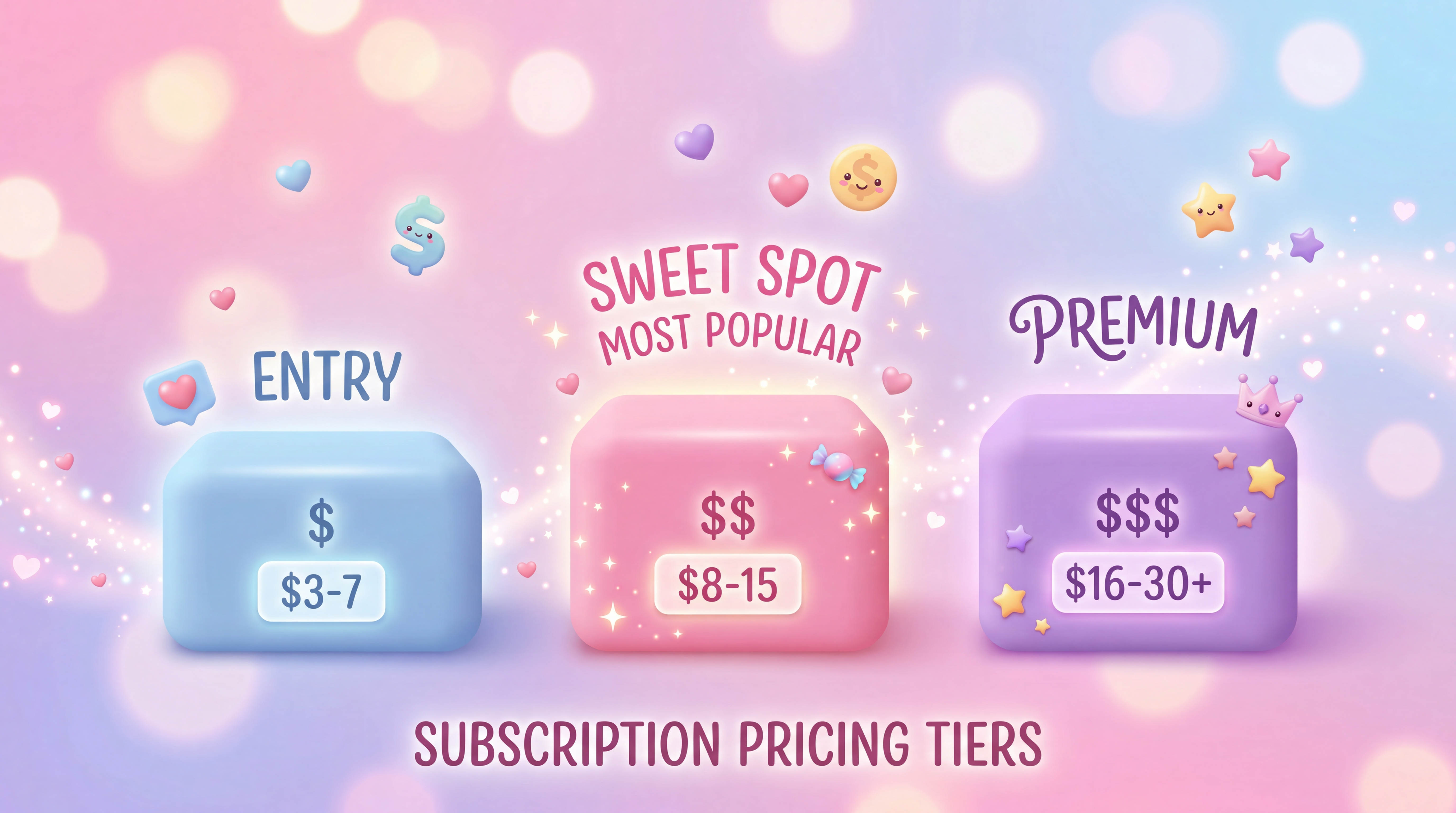
Should you charge $5 or $25? The answer depends less on what you think your content is worth and more on how your whole revenue funnel actually works. We dug into pricing data from hundreds of creators across niches to find the number that maximizes total monthly income — not just the headline subscription figure.
I changed my subscription price from $9.99 to $4.99 and my revenue went UP. Here's why.
It felt like a terrible idea on paper. Cutting your price in half sounds like panic, not strategy. But after three months of stagnant subscriber growth and a PPV open rate that had quietly plateaued, I ran the experiment anyway. Within six weeks, my total monthly revenue had climbed by about 30%.
The logic that unlocked it: your subscription price is not your revenue. It's one variable in a much larger equation. Your actual monthly income looks more like this: subscribers × (subscription price + average PPV spend + tips + customs requests). When I dropped my sub price from $9.99 to $4.99, my subscriber count nearly doubled within 45 days. And those new subscribers — the ones who came in because the barrier was lower — were buying PPV at roughly the same rate as my existing fans. The denominator got a lot bigger. The total number went up.
This is the fundamental insight that most pricing conversations miss. Creators get attached to their subscription price as a signal of their worth. And there's a real psychological component to that — we'll get into it. But optimizing for the number on your profile page is almost never the same as optimizing for your bank account. The two goals frequently pull in opposite directions, and the creators who understand that tend to out-earn the ones who don't.
That said, low price isn't always right either. There are niches, audience types, and content models where $20+ per month is genuinely the optimal number. What follows is the honest breakdown of how to figure out which category you're in — and how to make the math work either way.
The Three Pricing Models
Every successful creator I've talked to falls into one of three pricing philosophies. None of them is inherently superior — they just require different skills and different content strategies to execute.
Low Tier ($3–7/month): Volume and Chat Revenue
The low-price model only makes sense if you're good at the inside game. Setting a $4.99 subscription is essentially a statement: "I'm easy to try, but once you're in, I'm going to give you reasons to spend more." That means active chat, well-timed PPV drops, and a genuine effort to build individual relationships with fans rather than broadcasting content at a wall.
The math can be compelling. Say you have 300 subscribers at $4.99 and 40% of them buy at least one PPV per month averaging $12 each. That's $1,497 from subscriptions plus $1,440 from PPV — about $2,937 before tips and customs. Compare that to a creator with 80 subscribers at $14.99 whose fans mostly lurk and rarely buy PPV: $1,199 from subscriptions, maybe $200 from occasional PPV. Same amount of effort promoting, very different results.
The risk with low pricing is that you attract a higher proportion of people who subscribed purely because it was cheap and have no intention of spending more. Converting those subscribers to PPV buyers takes real chat skill and consistency. If you're not someone who enjoys sliding into DMs and building those micro-relationships, the low-price model will underperform relative to its potential.
Mid Tier ($8–15/month): The Reliable Middle Ground
This is where most established creators land, and for good reason. $9.99 is the single most common OnlyFans price point in existence, and it's not an accident. At $9.99, impulse subscribing still happens — it's under the psychological ten-dollar threshold, it's cheaper than a streaming service, and it feels like a reasonable trial investment. But it's high enough to filter out the purely casual browsers who would subscribe for a week and disappear.
The mid tier works well for creators who post consistently, have a defined content identity, and have enough of a social media presence that new visitors arrive with some warm intent already. You're not dependent on converting every subscriber through chat because your content itself is doing some of the retention work. PPV still matters, but it doesn't have to be your primary revenue engine.
If you're early in your creator career and unsure where to start, $9.99 is a defensible default. It gives you room to lower if growth stalls and room to raise if demand picks up — without either move feeling dramatic.
Premium Tier ($16–30+/month): Exclusivity as the Product
Premium pricing works when the subscription itself carries a clear value proposition beyond just "more content." That typically means one of three things: you're in a devotion-heavy niche where fans are highly attached and willing to pay for access, you have an established brand with years of content history and a proven track record, or your content category (fitness programming, professional cosplay, highly specific fetish content) is treated by your audience more like a service or collection than casual entertainment.
The premium model requires constant fresh content. Fans paying $25/month will churn fast if they're seeing the same posting cadence as someone charging $10. The bar for what "keeping up" looks like is genuinely higher. But for creators who can deliver — and whose audience has the budget and motivation — it's the most straightforward path to strong revenue from a smaller subscriber base. You don't need 400 subscribers at $25; 150 loyal ones gets you to the same place.
Which Price Works for Which Niche
Niche matters more than most people think when it comes to subscription pricing. Your audience's spending behavior, their expectations around exclusivity, and how competitive your content category is all affect what price point the market will actually sustain. Here's a breakdown of common niches with price ranges that tend to perform well based on patterns I've seen across creators.
| Niche | Recommended Range | Why It Works | Revenue Model |
|---|---|---|---|
| Foot / Fetish content | $6–12/month | Very large interested audience; high competition keeps price accessible, but devotion-heavy fans spend heavily inside | Sub + PPV + customs |
| Fitness / Workout | $12–20/month | Audience values expertise and the functional content (workout plans, nutrition tips) as a service, not just entertainment | Sub-heavy; PPV for bonus programming |
| Cosplay | $10–18/month | Collector mindset — fans want the full set. High perceived production value justifies higher price | Sub + set PPV drops |
| GFE (Girlfriend Experience) | $10–15/month | Emotional connection is the product. Fans are paying for access and conversation as much as content | Sub + tips + PPV + customs |
| Established creators (1,000+ subs) | $14–25/month | Brand equity carries the price. Fans are paying for the specific creator, not just content type | Sub-anchored, all revenue streams |
| New creators (under 100 subs) | $5–10/month | Lower friction helps build initial audience; focus on retention and chat at this stage | Build the base first |
| BBW / body-positive | $7–14/month | Devoted niche with strong community loyalty; mid-range sweet spot with solid PPV potential | Sub + PPV + chat |
| Dom/sub / kink | $10–20/month | Role dynamic creates high attachment; subs often treat it as a service relationship and spend accordingly | Sub + customs + tribute tips |
One pattern worth noting: the niches with the most devoted, attachment-based audiences (GFE, dom/sub, certain fetish categories) often produce the highest total revenue regardless of where the subscription sits, because fans in those categories spend disproportionately more inside the wall on PPV, customs, and tips. The subscription is almost a cover charge for the relationship.
The Real Math Behind Subscription Pricing
Let's run the actual numbers with a controlled example. Assume you have 100 profile visitors per week who are genuinely interested subscribers — they found you through a Reddit post, a TikTok, a shoutout, whatever. We'll look at what happens to your monthly revenue across three pricing scenarios, factoring in realistic conversion rates, PPV behavior, and tips.
Assumptions for the Model
- 100 engaged profile visitors per week = roughly 400/month
- Conversion rates vary by price (lower price = higher conversion)
- PPV average purchase: $12 per buyer per month
- Tips average: $8/month per tipper (roughly 10% of subs tip)
- Customs: 2% of subs request customs averaging $60 each
- OnlyFans takes 20%, so all figures below are pre-platform-cut gross
| Scenario | Sub Price | Conversion Rate | Active Subs | Sub Revenue | PPV Buyers (40% / 25% / 15%) | PPV Revenue | Tips + Customs | Total Gross |
|---|---|---|---|---|---|---|---|---|
| Low | $4.99 | 3.5% | 140 | $698.60 | 56 buyers | $672 | $196 | $1,566.60 |
| Mid | $9.99 | 2.0% | 80 | $799.20 | 20 buyers | $240 | $112 | $1,151.20 |
| Premium | $19.99 | 0.9% | 36 | $719.64 | 5 buyers | $66 | $50 | $835.64 |
The low-price scenario wins here — but notice how sensitive it is to that 40% PPV conversion rate. That number only holds if you're actively working the chat and sending well-targeted PPV messages. Drop that conversion to 20% and the low-price advantage shrinks considerably. Drop it to 10% and the mid-price model actually pulls ahead.
Now run the same scenario for an established creator with 5,000 monthly profile visitors and a built-in following:
| Scenario | Sub Price | Conversion | Active Subs | Sub Revenue | PPV Revenue | Tips + Customs | Total Gross |
|---|---|---|---|---|---|---|---|
| Low | $4.99 | 4% | 200 | $998 | $960 (40% × $12) | $280 | $2,238 |
| Mid | $9.99 | 2.5% | 125 | $1,248.75 | $450 (30% × $12) | $175 | $1,873.75 |
| Premium | $19.99 | 1.5% | 75 | $1,499.25 | $270 (30% × $12) | $105 | $1,874.25 |
Interesting — at higher traffic levels, mid and premium pricing become much more competitive because the conversion gap closes. Established creators can price higher and still get enough subscribers to make the math work. The key variable is always how strong is your PPV conversion strategy. That single number changes everything.
Your subscription price is the ticket price. The venue makes its money at the bar. Get people in the door, then have something worth buying inside.
Smart Discount Strategies That Don't Cheapen Your Brand
Discounts are one of the most powerful tools in a creator's arsenal — and one of the most commonly misused. Done right, a limited-time offer creates urgency and converts fence-sitters who've been passively aware of you for weeks. Done wrong, it trains your entire audience to wait for a sale before subscribing.
First-Month Introductory Offers
A 50% off first month (so $4.99 on a $9.99 page) is probably the most effective use of a discount. The logic is simple: it lowers the trial cost to something that feels genuinely low-risk, which gets more first-time subscribers across the line. Once they're in and experiencing the content, many will renew at full price. The key is that you're not discounting the ongoing relationship — just the trial period. Psychologically, this reads differently than a blanket price cut.
Bundle Deals: 3 Months for the Price of 2
This one works particularly well for fans who are already subscribed and considering whether to renew. Offering a 3-month bundle at a fixed price (essentially one month free) gives them a reason to commit longer, which means less monthly churn for you and more predictable income. Message your existing subscribers directly — something like "I'm running a limited 3-for-2 deal for existing fans this week" converts well because it feels exclusive rather than desperate.
Seasonal Sale Windows
Black Friday, Valentine's Day, and your birthday month are the three that most creators report success with. Valentine's is particularly strong for GFE and relationship-adjacent content. The psychology here is that seasonal sales have a built-in, socially understood reason — they don't feel like a creator scrambling for subscribers. They feel like an occasion. Run these for 3–5 days maximum to preserve urgency.
The Anchoring Principle
Always, always show the "before" price when running a discount. "Subscribe for $4.99 (usually $9.99)" is dramatically more compelling than simply "Subscribe for $4.99." The crossed-out original price tells the visitor what they're saving, and it reanchors their perception of your content's value at the higher number — so even when they're getting a deal, they're mentally valuing you at $9.99.
The Discount Trap to Avoid
If you run sales every other week, you stop having sales — you just have a price. Fans who follow you on social media will notice the pattern and simply wait for the next offer. Keep promotional discounts to 3–4 times per year maximum, treat them as genuine events, and let your full price hold the rest of the time. Scarcity only works if it's actually scarce.
Free Page vs. Paid Page: The Eternal Debate
This is probably the question I get asked most often by creators who are just getting started. The short answer is that there's no universally correct answer — but there are pretty clear patterns in who succeeds with each model.
The Free Page Strategy
A free page functions as the top of your funnel. Your subscription is $0, but nothing explicit is free — everything good is locked behind PPV messages. The advantage is volume: your subscriber count grows fast, you can message everyone on your list, and you're not asking anyone to commit money before they've seen what you do. For creators who are skilled at chat-selling and PPV timing, a free page can generate serious income because the potential customer pool is massive.
The downside is that you attract a lot of people who have zero intention of spending. "Free" removes the financial filter, and a meaningful percentage of free subscribers will ignore every PPV you send and never tip. Your open rates on PPV may be higher in absolute numbers but lower as a percentage, and you end up doing more chat work per dollar earned. If your chat conversion rate isn't strong, free pages can feel like a lot of effort for middling returns.
The Paid Page Strategy
A paid page pre-qualifies your audience. Anyone who subscribed already made a micro-commitment — they decided you were worth paying for. That changes the dynamic inside the wall. These fans are more likely to be genuinely interested, more likely to engage in chat, and more likely to buy PPV because they've already demonstrated spending behavior. Average revenue per subscriber tends to be higher on paid pages.
The trade-off is that your top-of-funnel conversion rate is lower. Someone discovering you for the first time needs more convincing to subscribe to a $9.99 page than a free one. This means your social media and external marketing has to do more heavy lifting — your profile, your pinned posts, your bio all need to sell the subscription before anyone clicks Subscribe.
The Hybrid Approach
Many creators run both: a free page that posts SFW teasers and redirects traffic to the paid page, or a free page where the explicit content is locked at individual PPV prices rather than accessible through a sub fee. This captures the volume benefits of free while maintaining per-content monetization. The hybrid works well if you have the bandwidth to maintain two active presences and the content pipeline to feed both.
My honest take: if you're strong at chat and DMs, start free. If you prefer to focus on content quality and posting consistency over relationship-building, start paid. Most people eventually find their way to whichever model suits their personality — might as well start there.
Fansly's Tier Advantage (and How to Use It)
OnlyFans gives you one subscription price. Fansly gives you the ability to set multiple tiers, which is genuinely a structural advantage for certain revenue strategies. If you're active on Fansly or considering it, understanding how to build a tier stack is worth the time.
A Tier Structure That Works
The most common approach that performs well is a three-tier setup: a basic access tier around $5–7, a standard tier around $14–17, and a premium tier around $28–35. Each tier needs a clear, concrete difference in what it includes — not just "more content" but specifically what more content.
A practical example: Tier 1 ($6/month) — photo sets, solo content, timeline posts. Tier 2 ($15/month) — everything in Tier 1 plus explicit video content, behind-the-scenes posts, and direct message access. Tier 3 ($30/month) — everything in Tier 2 plus priority chat responses, monthly custom photo, and name/shoutout in content.
The key is that each step up needs to feel like a meaningful unlock, not just a badge. If Tier 1 and Tier 2 look basically the same to the subscriber, nobody upgrades.
The Tier Upgrade Funnel
Get fans in at Tier 1 where the price friction is low. Over the first 30–60 days, you have natural upgrade opportunities: mention features they're missing ("I just dropped a new video in Tier 2 tonight"), run limited-time upgrade offers, or simply message your Tier 1 subscribers directly when you add something compelling to Tier 2. Fans who are already engaged and spending $6 per month are far easier to convert to $15 than cold prospects are to convert to anything at all. The upgrade funnel on Fansly is one of the most underused revenue levers in the creator toolkit.
How to Know If Your Price Is Wrong
Price isn't a set-and-forget decision. Your market, your audience, and your content quality all change over time, and the right price changes with them. Here are the signals that tell you something needs to adjust.
Conversion Rate Is the Primary Signal
If you're driving consistent traffic to your profile through social media, collabs, or Reddit posts, and fewer than 1% of those visitors are subscribing, your price is probably one of the friction points. (Other culprits: weak bio, not enough free preview content, unclear value proposition — but price is always worth testing first.) A healthy conversion rate for a paid page with good warm traffic is typically 2–4%. If you're significantly below that, consider a temporary discount to test whether price is the blocker.
Conversely, if you're pulling 100+ new subscribers per month with minimal active promotion, you're likely underpriced. When people are subscribing with low friction despite minimal marketing, demand is outpacing your price — a classic underpricing signal. You have room to raise, and doing so won't cost you as many subscribers as you fear.
Churn Rate Tells You About Content Value
If subscribers are consistently canceling within 30 days at a high rate — above 40–50% first-month churn — the issue usually isn't the price. It's the content delivery. They subscribed based on an expectation (set by your social media, your bio, your free teasers) and the page didn't deliver on that expectation. Lowering the price doesn't solve a broken promise. What you need is to either adjust the expectation-setting before the subscribe, or audit what the post-subscribe experience looks like.
A healthy first-month retention rate is somewhere above 55–60%. If you're significantly below that, work on your onboarding: do you send a welcome message? Do you have a pinned post that tells new subscribers where to find the best content? Do you post within the first 48 hours of someone's new subscription so they immediately see activity? These small touches have measurable impact on renewal behavior.
Engagement as a Health Indicator
Low engagement — few likes, almost no DM replies, nobody buying PPV — is often a sign of mismatched pricing rather than bad content. If your subscribers feel like they're getting what they paid for passively but aren't motivated to go further, you may have priced yourself into a passive-consumption audience. Active, spending fans tend to come from lower price points with high engagement, or from premium price points where they feel they have a real relationship with the creator.
When to Raise (and When to Lower) Your Price
Changing your subscription price is one of the more nerve-wracking decisions as a creator, because it feels permanent and public. It doesn't have to be either. Here's a practical framework for both directions.
When to Raise
- Consistent PPV sell-through: If you're sending PPV messages and a high percentage of subscribers are buying — say, 35%+ — that's evidence of an engaged, spending audience. They're clearly getting value at your current price and have demonstrated willingness to pay more. You're leaving money on the table.
- Steady referral flow: If new subscribers frequently tell you they heard about you from another fan, you have an organic growth loop happening. That kind of word-of-mouth momentum can absorb a price increase better than cold traffic alone.
- Renewal rate above 60%: If most of your subscribers are staying month after month, your content is delivering real value. Fans who've been with you 3+ months are unlikely to leave over a $3–4 price increase. They already know what they're getting.
When to Lower
- Slow growth for 60+ days: If your subscriber count hasn't meaningfully moved in two months despite consistent social posting, price may be the friction. Run a limited-time discount first to test; if that spikes subscriptions, you have your answer.
- Entering a new niche: If you're pivoting content direction or trying to reach a new audience, your existing brand equity may not carry over. Lowering the price temporarily while you rebuild social proof in the new niche makes the transition smoother.
- High early churn: If you have a lot of first-month cancellations and you've already audited and improved your content delivery, lower price can reduce buyer's remorse by lowering the initial financial commitment.
Grandfathering Existing Subscribers
When you raise your price, always grandfather your existing subscribers at the old rate. OnlyFans doesn't do this automatically — you need to communicate it directly via mass message: "My subscription is going up to $14.99 next month. If you're already subscribed, your rate stays at $9.99 as long as you remain active." This is both ethical and strategically smart. It rewards loyalty, it dramatically reduces the churn spike you'd otherwise see at the price change, and it generates genuine goodwill. Fans who know they're getting a special deal because they were early tend to be more engaged, not less.
Pairing Price with Strategy
Your subscription price is the entry point. The subscription itself is rarely where the majority of your income lives — most successful creators earn 60–70% of their revenue from what happens inside the wall. That means the price decision you agonize over on your profile page is really just setting the context for a much more important series of decisions about PPV timing, chat strategy, and how you identify and engage your highest-value fans.
The operators who consistently out-earn their peers aren't necessarily charging more or posting more content. They're better at knowing which of their subscribers is most likely to buy, and they're reaching those people at the right moment with the right offer. A fan who just renewed is in a different headspace than one who's been quiet for three weeks. A fan who opened your last three PPV messages without buying is a completely different conversation than one who buys everything you send.
Pair your pricing strategy with AI-powered upselling — tools like Content Flow (content-flow.org) and SuperCreator can help you identify high-value subscribers and time your PPV offers for maximum conversion. Instead of blasting the same PPV message to your entire subscriber list, you can segment by behavior and send targeted offers that match each fan's actual spending patterns. That kind of precision turns even a modest subscriber count into serious monthly income, regardless of where your subscription price sits.
Ultimately, the best subscription price for you is the one that, combined with your chat strategy and PPV cadence, produces the highest total monthly revenue for the amount of time you're investing. That number is different for every creator, and it changes as your audience grows. Treat it as a variable you revisit every 60–90 days rather than a permanent identity — the creators who do tend to earn more, consistently, than the ones who set it once and forget it.